We’re just over 3 weeks into our trip! The first two weeks, especially, were a good test for everything we’re wearing and carrying.
Here’s what we’ve learned so far:
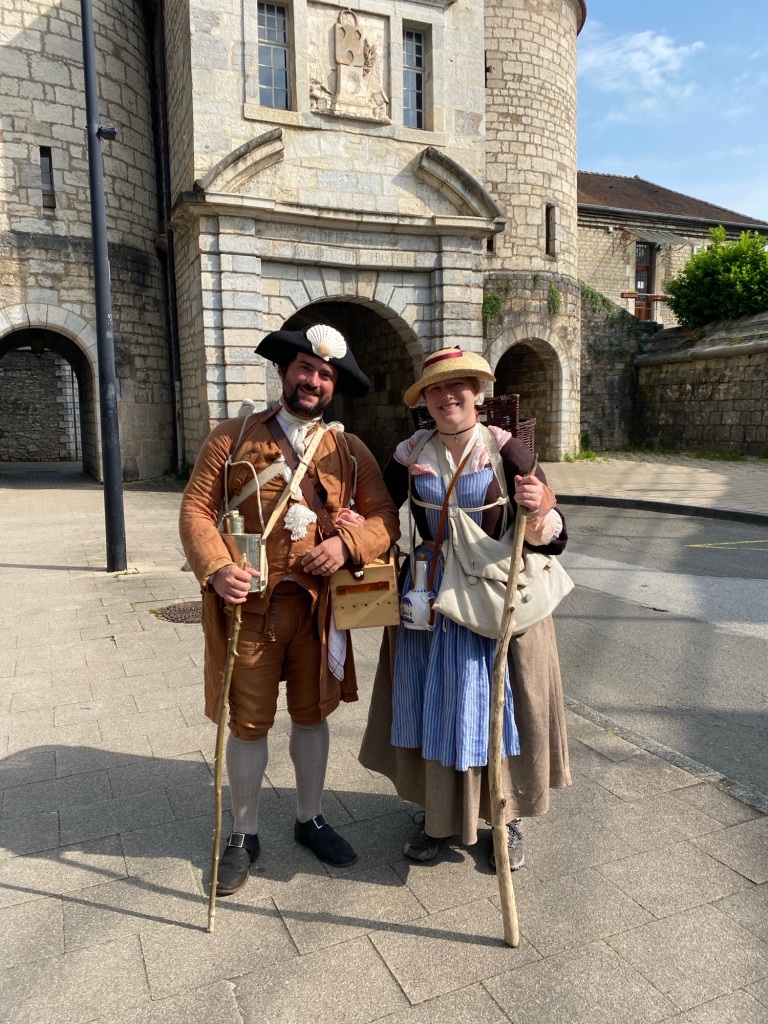
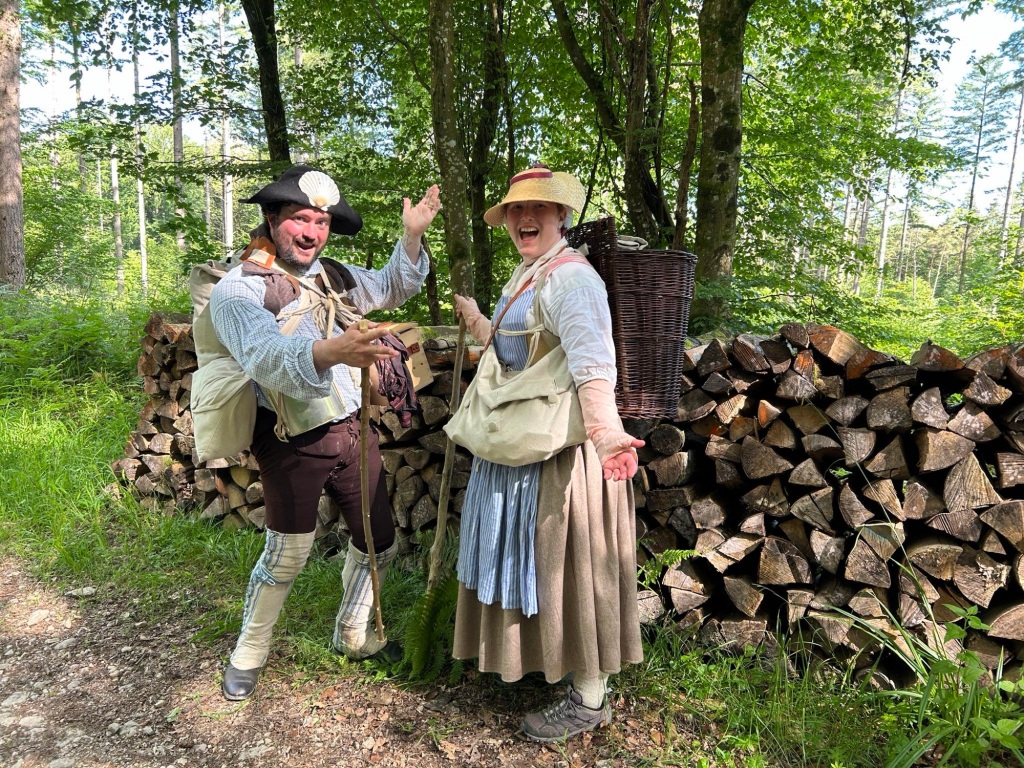
- STRAPS: We are each carrying ~50lbs of gear. Yup. Leather straps, or alternatively, baggage slings that don’t fold in on themselves, are essential in distributing this weight. Adam’s ‘Uhl’ knapsack replica is copied from a cheap American 1770s backpack, and is at least 10 years old. He’s improvised with jamming padding under it, but larger straps would have been a good idea. For Adam’s replica “marmot” box, we used 1” cotton webbing as the strap, but it folded in on itself into a painful 1/4” narrow cord. Esther ended up stitching an 8” piece of her basket strap onto the webbing to help keep it intact. It worked for a bit, but then Adam bought a leather belt, cut the belt buckle off, and now that’s his strap. It works so much better! Esther’s basket straps are doing great and are long enough to tie around her waist to distribute the load. They’re made from a thicker and broader hemp webbing. We fully understand why all contemporary military gear throughout Europe used leather bag straps, rather than fabric.
- STAYS: Speaking of support, Esther’s stays (corset in French) have actually been really helpful! She hasn’t had any issues with her lower back and they’ve helped support the basket tied around her waist. That being said, she thinks she should have taken more time to properly fit them, since she didn’t try the mock up on with the full weight of petticoats.
- STICKS: Also on the theme of support, Esther found a walking stick ~6 days into the trip and oh man has it helped. She’s quite attached to it now. Adam also found a sapling that had bent into the path, but he left it at a restaurant in Laon and it got thrown out – because it was an actual stick. He has since found another stick that was previously a small tree. We’ve commissioned pilgrim staffs from a regional woodworker, based on period images, and we’re hoping to get those when we’re in Italy. While modern trekking poles are usually paired, we’ve yet to see this in any period images of people on the road, and having one hand free is useful.
- SHOES: We’ve experimented with a range of (4) types of footwear, from handmade period shoes, machine-made period shoes, to vintage style tied boots, to modern hiking shoes. The crucial part regardless of appearance is fit, breaking them in, and having appropriate (dry!) socks and padding! We’ve both added insoles to our shoes and they’ve made both of us much more comfortable, particularly on asphalt-heavy days. Given more time, we (Adam, mostly) would have liked to experiment with sabot (which are all wooden clogs), but those were too bulky to justify for now.
- LAYERS: We’re both wearing a number of layers of clothes, but that’s kept us safe from sunburn and stinging and thorny brush – and there are LOTS of stinging nettles. Esther got one sunburn in the tiny triangle of uncovered skin between her mitt and her shift and another on her neck in the tiny exposed triangle left after putting on her handkerchief. Wearing layers also means you can take layers off or put them on, depending on the weather. Esther really appreciates her mitts, both the wool pair and the linen pair. The linen pair is fantastic for hot days. Adam challenges anyone reading this to find any photo of their ancestors PRIOR TO WWII wearing anything except a full set of 2-3 layers of garments. Being fully dressed historically was both a function of society AND more time outside without climate control.
- SOCKS: Dry socks make a world of difference. Esther got blisters during week 2 because of walking in the rain and getting wet feet, even though we walked on pavement and not grassy footpaths. Thankfully the blisters are gone, and we avoided walking in the rain all of last week! Esther’s wearing wool stockings and Adam wears two pairs of socks – one inner pair that has a finer weave and one thicker outer pair to keep his foot from moving too much in his boot. The one experiment that may transpire in Italy is Adam greasing his feet without socks, per the 1740s advice of Marshal Saxe.
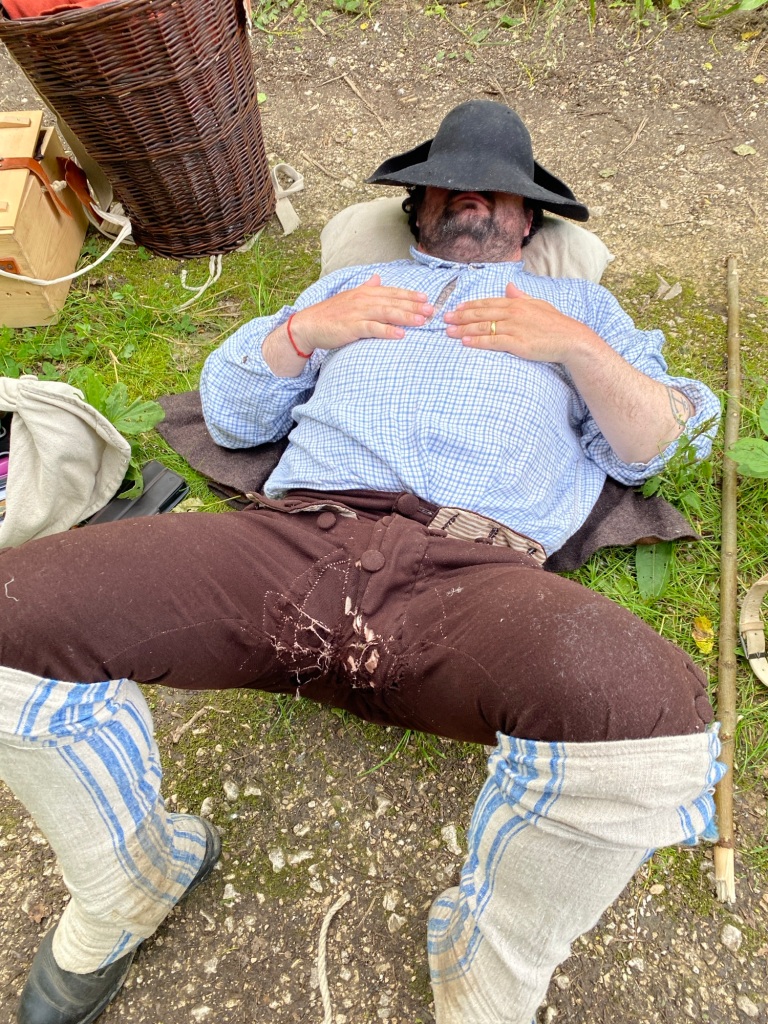
- FABRIC: We cannot emphasize this enough: if you’re making historical clothing and plan on giving it lots of wear, BUY GOOD QUALITY CLOTH. Adam’s 1740s wool suit is made from a wool cloth that has not worn well. It rips easily and in places where it’s rubbed against – for example, where his bags rub against the coat – the fabric is threadbare or worn through. We’ve been walking for 3 weeks and noticed the wear just days in. It’s incredibly frustrating to have to spend so much time fixing one’s pants every night before bed. And while there were certainly shoddy textiles 300 years ago, the plants, animals and production generally produced far more durable and practical fabrics than we often give them credit for.
- WATER: Esther is carrying a replica 18th century French ceramic faience bottle. The bottle itself is quite heavy. It holds about a liter of water and when full, is even heavier. However, it does keep the water cool for a long period, and generally we only need to refill it once on the longer days. Adam is carrying a replica tinned steel Prussian-style army canteen, sized for a squad of 6 men to share. While it is far more likely that pilgrims just drank from available wells, water courses and standing puddles, we are less eager to drink modern water polluted by septic runoff, fertilizers, petrochemicals and pesticides. Our canteens are period solutions to a modern problem, and working fairly well.
Overall, we’ve learned that our gear has limits, so we need to have some limits, too. Our wool clothes are fine in the rain, but not for extended periods of time. We try to plan rest stops around expected rainy weather, like people would have done historically. Inversely, our historical layers protect us from heat, but we also modify our timing to walk as early as possible to avoid the heat of the midday. Unfortunately, we’re limited by a 90-day tourist visa, so we can’t just stop for a few days – we do have targets to hit so we can leave Italy on time. Also, our paid accommodation requires specific dates and hours for their own planning (as opposed to, « we’ll arrive sometime next week when the weather clears »). Thankfully though we’ve been able to find rides or trains to get around bad weather when we need to, and we’re hoping that will continue going forward. Modern meteorology in particular is one of our biggest boons on this trip.
In essence, dressing for this trip in period attire has been a resounding success, but it also has humbled us and spurred us to make our itinerary more flexible. Natural fibers are amazing, when properly made and appropriately layered, and everything is at a scale that we (or fellow artisans) can make and repair ourselves. Things are bulkier, leave you satisfyingly fatigued, and they make you sweatier, but that’s the point of going on a hiking trip, right?



 Time Traveling Tales
Leave a comment